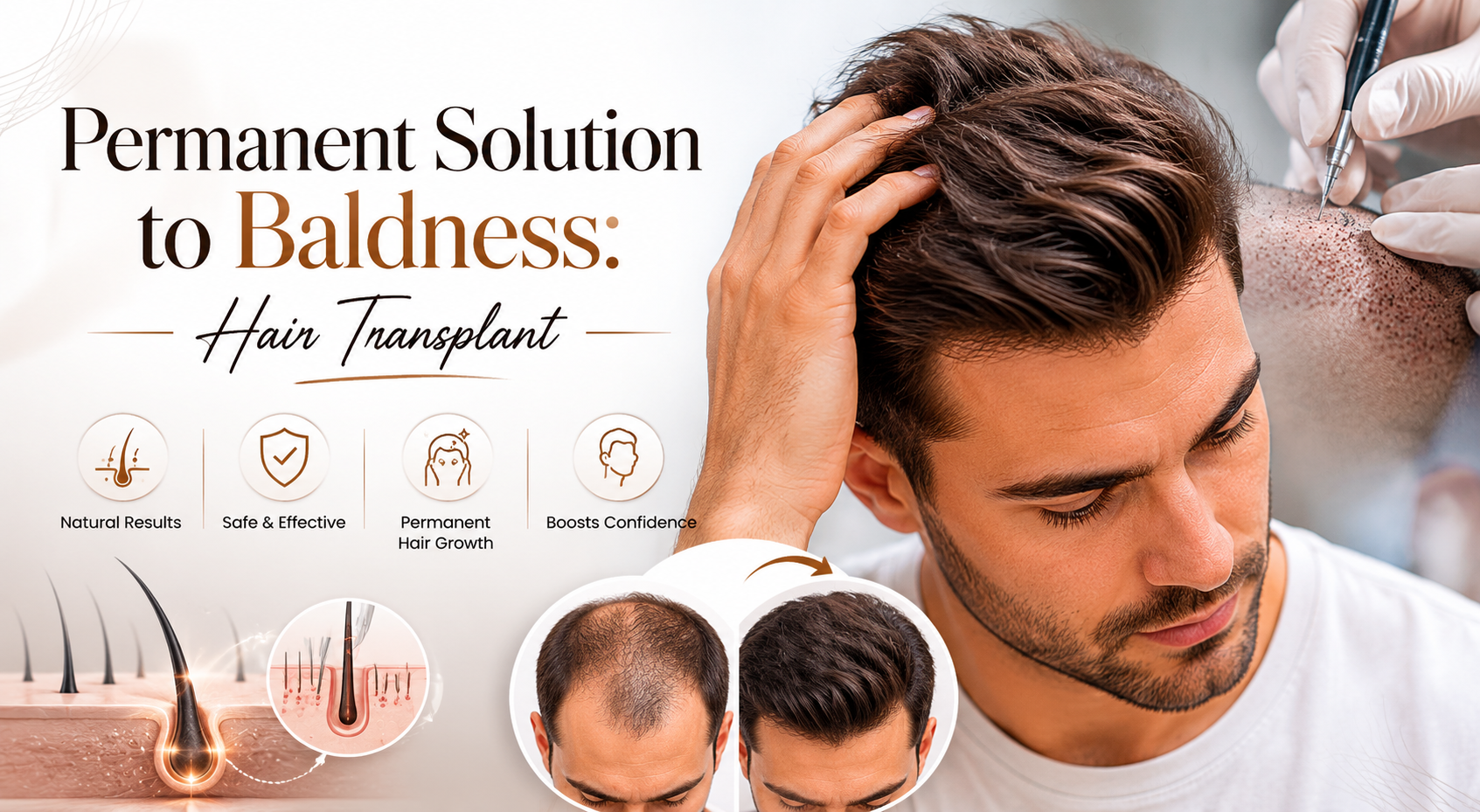
Hair loss and baldness can lead to low self esteem and deeply affect your confidence. Hair transplants are an accessible option for those seeking a solution to their baldness.
Before you make the choice to get a hair transplant, let us understand the different methods of hair transplant. This will help you in making the right choice when getting a hair transplant.
Out of all the techniques available for hair transplant, two of the most effective methods are Follicular Unit Extraction (FUE) and Direct Hair Implantation (DHI). Both the methods are successful and offer promising results, but they differ on the way the follicles are extracted, handled and implanted.
To choose the right option, it becomes imperative to understand the difference between FUE, DHI and the older Follicular Unit Transplantation (FUT) method.
Let us understand hair transplant techniques as discussed below:
1.Follicular Unit Extraction (FUE)
FUE is considered one of the most advanced hair restoration techniques. In this procedure, individual hair follicles are extracted from the donor area (typically back of the scalp) using a micro-punch tool. These follicles are then transplanted into the recipient area where hair growth is needed.
Steps involved in the procedure:
1.Local anesthesia is given before starting the treatment.
2.Hair follicles are carefully extracted one at a time using a specialized punch instrument.
3.The collected follicles are then placed into small incisions created in the targeted recipient area.
Benefits of FUE :
Minimally invasive: Because follicles are removed individually, the procedure does not require large cuts, allowing for a smoother and quicker recovery.Minimal visible scarring: FUE leaves behind tiny dot-like marks that are much less noticeable compared to the linear scars often seen with FUT.
Quicker recovery period: Patients are usually able to resume daily activities sooner than with many other hair restoration methods.
Natural-looking outcomes: The accurate extraction and implantation of individual follicles help create a more natural hairline appearance.
2.Follicular Unit Transplantation (FUT)
In the FUT method, a strip of skin containing hair follicles is removed from the donor area. The strip is then carefully dissected under the microscope to separate the individual follicular units, which are to be transplanted to the recipient area. FUT is comparatively an older hair restoration technique and is widely known as the “strip method” also.
Steps involved in the procedure:
1.A thin strip of scalp tissue is surgically removed from the donor area.
2.The extracted strip is carefully dissected to obtain separate follicular units.
3.These follicular units are then implanted into areas of the scalp affected by hair loss.
Benefits of FUT :
Greater follicle harvesting capacity: FUT allows the extraction of a larger number of follicular units in a single session, making FUT method suitable for individuals requiring extensive hair restoration.
Higher follicle survival rate: As follicles are obtained from a strip of scalp tissue, their survival rate may be higher compared to FUE, where some follicles can be damaged during the extraction process.
3. Direct Hair Implantation (DHI)
DHI is a modified version of FUE that uses a different kind of implantation method. In DHI, hair follicles are extracted similarly to FUE, but the key difference lies in the implantation process. DHI uses a special tool called the ‘implanter pen,’ which allows for simultaneous extraction and implantation, reducing the time the follicles spend outside the body.
Steps involved in the procedure:
1. The extracted follicles are implanted directly into the scalp using an implanter pen.
2. Follicles are extracted individually like in FUE.
Benefits of DHI:
No incisions needed: In DHI technique, there isn’t any requirement of creating incisions in the recipient area before implantation.
Improved precision during implantation: The use of an implanter pen gives the surgeon a better control over the depth, angle, and direction of each hair follicle, helping achieve more natural-looking results.
Quicker healing process: Since no incisions are involved, recovery is generally faster when compared to other hair transplant techniques.
With this table you can easily compare between the three methods of hair restoration and your surgeon can help you decide.
| Factor | FUE (Follicular Unit Extraction) | FUT (Follicular Unit Transplantation) | DHI (Direct Hair Implantation) |
| Extraction Method | Individual hair follicles are extracted using a micro-punch tool. | A strip of skin is removed from the donor area to collect multiple follicles. | Individual follicles are extracted and implanted immediately using a Choi pen. |
| Scarring | Leaves tiny, dot-like scars that are usually hard to notice. | Leaves a linear scar at the donor site, which may be visible with short hairstyles. | Minimal scarring due to no large incisions. |
| Recovery Time | Faster recovery; most people resume routine activities within a few days. | Longer healing period because of the strip removal method. | One of the quickest recovery times with minimal scalp trauma. |
| Implantation Technique | Hair grafts are implanted into pre-created incisions in the recipient area. | Similar implantation process to FUE but requires more graft preparation. | Uses a Choi implanter pen for simultaneous implantation and placement. |
| Control Over Hair Placement | Good control over angle and direction, depending on surgeon expertise. | Comparatively less control due to strip extraction technique. | Highest precision in controlling angle, depth, and direction for natural-looking results. |
| Invasiveness | Minimally invasive procedure. | More invasive because of strip removal. | Minimally invasive with reduced tissue trauma. |
| Suitable For | Patients looking for minimal scarring and shorter recovery. | Patients require a higher number of grafts in one session. | Patients seeking precise hairline design and natural density. |
| Overall Result | Natural-looking results with proper graft placement. | Effective for large graft requirements but may leave visible scarring. | Highly natural-looking outcomes due to precise implantation technique. |
Why choose Dezire Clinic for your Hair Transplant?
Choosing the right clinic is just as important as choosing the right hair transplant technique. At Dezire Clinic, we focus on personalized treatment planning, advanced hair restoration technologies, and natural-looking results designed to address your long -term goals.
1. Experienced hair transplant specialists
2. Advanced techniques
3. Customized hair restoration plans based on individual hair loss patterns
4. Focus on natural hairline design and density
5. Modern infrastructure with patient-centric care
6. Assisted guidance from consultation to recovery
Whether you are considering FUE or DHI, expert evaluation can help determine the most suitable approach for achieving long-lasting and natural-looking outcomes. Book your consultation with Dezire Clinic today and take the first step towards restoring your confidence with expert hair transplant solutions.